


Mythical Creatures: Exploring the Dark Origins and Myths of Vampires
Updated: Oct 1

The night is their domain. Vampires hunt their prey in the streets, luring their victims with their charismatic charm and chiseled good-looks. But once "permission" is granted and the door is open, all bets are off. The line between life and death hangs precariously thin—for the vampire must satisfy an insatiable thirst for blood.
Despite their murderous reputation, vampires have long held captive our attention. Where did this fascination begin? Was it in the mist-covered, treacherous cliffs of Transylvania, or in the gory tales of Vlad the Impaler? What does the Romanian vampire folklore tell us of these bloodthirsty creatures of the night? What about suggestions on how to ward off these monsters? How does Count Dracula fit into the lore?
Join us as we explore the chilling origins of vampire folklore, and uncover the connections between vampiric creatures, witches, and werewolves. Shut your windows, bolt your doors, and have plenty of garlic bulbs handy, folks.
Earliest Origins—Before Transylvania
Egypt

In Egypt, we have Sekhmet, a fierce goddess who is the daughter of the sun god Ra. She is depicted with a lion's head and whose dominion is war, destruction, plague, and healing. Her cult worship spanned circa 2600 BCE-5th century CE, evidenced by iconography, shrines, statues, and even temples at Kom el-Hisn and Memphis—the temple at the latter location has been theorized from textual sources but not yet found.
Sekhmet is the "vengeful manifestation of Ra's power" through the use of the "Eye of Ra" (Parikh, Sekhmet’s Family section; Pinch, p. 325). In other words, she is called upon sometimes to do Ra's dirty work of destruction. She embodies the immense power of the sun—her breath stirs up red-hot desert winds that scorch enemies to cinders; she breathes out fire (Parikh, The Origins of Sekhmet section; Wilkinson, R., p. 181). She also could readily unleash plagues to kill off people.
However, there is a gentler side of Sekhmet—priests invoked her as a healer, giving rise to a class of physician-priests called "Sekhmet's priests." Depending on the ritual need, region, and context, this goddess shows a dualistic manifestation of the Eye of Ra—as Sekhmet, a fierce destructive lioness and as Hathor, a benevolent healing cow deity (Wilkinson, R., pp. 181-182).
Sekhmet had a definite thirst for blood. When an aging Ra became fed up with mankind for its rebellion against his rule, he received advice from his council of gods and sent Sekhmet to mete out punishment, using his Eye of Ra (Pinch, p. 452-453). In the desert, Sekhmet slaughtered countless humans with "evil images" and "wicked plots" of overthrowing Ra in their minds. As she waded through the bloody carnage of bodies, she became enraptured with drinking human blood (Masters, p. 44). When Sekhmet returned to the palace in the evening, she found her bloodlust far from satisfied—she'll have to resume the massacre of humans tomorrow.
Ra now took pity on mankind and decided to stop the vengeful goddess; else she would wipe out all of humanity. Ra ordered jars of beer to be dyed red—resembling blood—and had them poured out throughout the land of Egypt during the night. In the morning, Sekhmet discovered "blood" in the fields, and believing it to be from humans, drank it up voraciously. She drank so much that she lulled herself into a drunken slumber (Guilhou, p. 2). On her return to the palace, Sekhmet was appeased and more peaceful—becoming the Hathor aspect of the Eye of Ra, sparing the rest of mankind.
Mesopotamia

In Mesopotamian mythology, specifically in Akkadian and Sumerian cultures (2000-500 BCE), Lamashtu, or or Lamaštu, a demoness who preyed on pregnant women and newborns, causing disease, miscarriage, and cot death. If a pregnant woman's belly was touched seven times by Lamashtu, the infant would die (Black, Green, p. 116).
Lamashtu was frequently depicted as a hybrid creature with a hairy human body, a lion head, donkey teeth and ears, and bird-like talons on her feet. Her hands were stained with blood, which some interpret as her drinking the blood, which is a weak link (ibid., p. 116). Lamashtu was unusual in that she performed evil acts on her own authority. She is shown in iconographic art in plaques and amulets as having a pig suck one of her breasts and a dog at the other breast, likely symbolizing a savage inversion of maternal instincts and association with unclean animals.
Watch Video: The VERY Messed Up Origins of Vampires
Often shown riding on a boat, and habitually atop a donkey while on the boat, Lamashtu sailed through the river of the underworld. The protection against Lamashtu involved wearing amulets and installing talismans (Said, Object 1984.348)—placed near beds, doorways, or other vulnerable spots. Images of Pazuzu on pendants, plagues, statues, and other objects repelled her because he was her demonic rival (Said, Object 1993.181).
Additionally, we have the Gallu (2500-100 BCE), demonic underworld spirits who dragged people to Kur—a land of the dead. Featured in exorcism incantation cuneiforms, the Gallu were described as part of the "Seven Spirits"—including the Utukku, Alû, and Etimmu, among others—who gorged on human flesh and drank blood. These spirits had parallels to vampire mythology, although some scholars maintain that no actual link exists with the Slavic/East European vampire folklore.
Hebrew

In Hebrew mythology (1000 BCE-1000 CE), Lilith is a night-demoness with wings and long hair. This demon is a succubus preying on solitary men, slumbering at night. Later, in some Jewish folklore, Lilith is depicted as Adam's first wife before Eve. Because she refused to submit to him, she chose to flee the Garden of Eden.
Lilith has loose connections with vampire mythology. In Jewish Rabbinic traditions after 500 CE, she is known for snatching newborns and even drinking the blood of infants. Lilith's blood-drinking behavior is contested though, as some scholars believe folklore about Lamashtu have been merged with those of Lilith.
From the fourth to the eighth centuries in Mesopotamia, analysis of Jewish incantation bowls and amulets (both used to ward off demons) that identified Lilith as the center figure, show that this demoness can shapeshift to look like either the wife or husband of a married couple to seduce the partner. Then after the wife gives birth, Lilith would seek to kill the child. Jewish households often had these incantation bowls buried upside-down somewhere in the house to trap the demon spirit and thwart its activities.
Greek

In Greek mythology (600 BCE-third century CE), we have Lamia, the beautiful queen of Libya and daughter of Poseidon, who caught the eye of Zeus. They had a love affair, resulting in several children. A jealous Hera, Zeus' wife, kidnapped and/or killed all of Lamia's children. Wracked with grief at the loss of her children, Lamia was driven mad. She started hunting other people's children and devouring them. In some traditions, she was then transformed into a hybrid serpentine monster—upper body is a woman and lower body is that of a serpent. Other portrayals show Lamia's appearance as a "hairy monster" with large talons.
Folklore later depicted Lamia as a blood-drinking monster or a "night-haunting spirit" feeding on children. Other stories depicted her as being a phantom-like creature who seduced young men and ate their flesh.
Vitality of Blood: Homer's Odyssey

One of the earliest written accounts regarding the origin of the concept of blood imparting strength, vitality, and memory can be traced to Homer's The Odyssey (roughly 750-700 BCE). Here we have the hero, Odysseus, travelling to the Land of the Dead (Cimmerian territory) to consult with dead spirits to learn the route home to Ithaca and the dangers lying on the way.
Before summoning the spirits, Odysseus is required to kill a black ram and a black ewe to spill their blood into a pit, from which the spirits would drink the blood. The blood draws the swarming dead spirits to it, giving the dead strength to speak, recognition of the living, and recall of their lives. Tiresias, a blind prophet, gives Odysseus the prophecy he needs and the other spirits, among them Odysseus' mother, Anticleia, impart encouragement and revelations he needs to return home.
Vrykolakas

By the late Byzantine period (mid-17th century), the vrykolakas folklore emerged. The vrykolakas was a "revenant vampire"—a reanimated corpse come back to haunt and kill off family members and friends, due to excommunication, improper burial practices, or a sinful life (Lawson, p. 365). This vampire's corpse doesn't decompose like normal dead bodies: its skin is extremely tough and becomes so swollen up that it can barely bend its joints. The skin is stretched like the "parchment of a drum" (ibid.).
Such a deadly monster can appear in the middle of the day and cause the sudden death of the individual who sees the vrykolakas (ibid., Lawson paraphrasing the treatise of Leo Allatius). These Christian-influenced fears on sin and damnation merged with villagers' older pagan beliefs about the "restless dead."
Roman/Greek

In Roman mythology (third century BCE-fourth century CE), the precursor to vampires was the striges, plural form of the Greek singular strix. Striges were bird-like creatures (the "screech owl" may be the inspiration) that preyed on sleeping people, sucking their blood and eating their flesh. They started out as witches or women who were cursed to undergo monstrous transformation into large-headed gray birds with hooked beaks and talons, which cried with distinct owl-like shrieking. They flew at night seeking, in particular, cradles with babies to feed on their organs and drink their blood.
Roman striges folklore merged with older Greek traditions to form the Roman traditions on striges.
Greek folklore placed striges into two classes (Lawson, pp. 180, 211, 250):
1. Demoness (precursor demoness was Gello) who preyed on infants, sometimes devouring their livers and internal organs. The people of Lesbos held these Gello-inspired creatures as responsible for the early deaths of infants (Lawson, p. 177, 181).
2. Women, or witches, with power to transmute into predatory birds.
Both Greek strix types share behaviors of attacking and preying on infants—striking women sometimes and at rare times, even men. Striges had a "thirst for children’s blood" and a "taste for human flesh" (Lawson, pp. 178, 181-182).
Watch Video — Vampires: Origins and Real History
Vampire Mythology of East Europe
Romania
Vampiric Folklore Evolution

Vampiric folklore grew from a blending of pre-Christian Slavic and Dacian beliefs about the restless spirits of the dead and the deleterious consequences that may occur from an improper death. In the 14th century and beyond, Eastern Orthodox Christianity took hold. Church teachings on sin, burial rites, and the soul's judgment fused onto older folklore fears, producing Christianized markers of vampirism—e.g., excommunication, suicide, and unbaptized infants.
The influence of European folklore, particularly Transylvanian Saxon and Slavic traditions, added characteristics to the Romanian vampire mythos. By the 18th century, Romanian folklore told of the strigoi as undead beings that rose from their graves, preyed on the living, especially their families, and could be repelled by garlic and holy symbols. More on strigoi in the immediate section below.

The mountainous geography of Romania, with the Carpathian Mountains within its borders and its cultural isolation, played a significant role in shaping its unique vampire mythology. Located at the crossroads of Europe and Asia, Romania was a buffer zone between Eastern and Western cultures. For much of its history, it was a peripheral region, relatively isolated from the mainstream of European culture. The country's geography also cultivated a strong sense of regionalism, with different ethnic groups developing their own distinct traditions and mythologies.
Three Romanian Vampiric Creature Types
Three distinct vampiric creatures are found in Romanian mythology: strigoi, moroi, and pricolici.

Strigoi are troubled spirits that come back from the dead to torment their family, drain the blood or vitality of the living, and spread disease. They were creatures of darkness and chaos, roaming the countryside at night to feed on the blood of livestock and humans.
Strigoi were responsible for unexplained deaths, livestock illness and deaths, and plagues that villagers attributed to a distressed fatality ("bad death") of the reanimated creature—whether from suicide, excommunication, or violent/sudden death. Sometimes strigoi were marked by a physical trait, such as being born with a caul, having extra teeth or a tail.

Moroi were also restless undead creatues—typically, they're the vengeful spirits of unbaptized infants or those who met their maker in a way that left them unfinished. Rising from their graves, moroi haunt the living, draining energy, sowing illness, and invading nightmares. Some legends portray them as ghostly, haunting presences, mere whispers of evil; whereas others see moroi as more formidable, though less bloodthirsty, than their strigoi cousins.

Pricolici are shape-shifting vampires able to transform into werewolves. These shapeshifters prowl around at night to prey on livestock or people. Blending the savage instincts of werewolves with the vampiric thirst for blood, pricolici represent a primordial evil, unchecked by human reason or restraint like the strigoi or moroi varieties.
None of these creatures, however, were harmed or killed by sunlight. Light vulnerability was a non-Romanian belief that developed elsewhere in modern times, as in the movie Nosferatu (1922). Romanian vampires were active at midday or midnight, although the cover of night helped to conceal their nefarious deeds.
Other Slavic Regions

Bulgaria, Croatia, and Bosnia-Herzegovina: Folklore told of the Upir, also known as Upyr, who are region-specific vampires arising from the dead due to curses or evil deeds. They're often described as blood-sucking creatures with supernatural strength. In Croatia and Bosnia-Herzegovina, the upir folklore is often linked with witches and dark magic.
Hungary: Hungarian folklore has the Tündér, an undead creature that drinks blood but can also be benevolent. They're often associated with mysterious deaths and unexplained occurrences.
Poland, Ukraine, and Belarus: In these countries, vampires are known as the Upiór, similar to the Bulgarian Upir. They're often portrayed as more sinister and malicious beings, feeding on human blood and causing terror in rural communities.
Serbia and Montenegro: In these regions, vampires are associated with the Slavic Vampir and Vukodlak traditions of "bad death"/improper burial framework discussed previously under strigoi and in more detail in Connections to Witches and Werewolves.
Techniques to Deter Vampires

Common folklore for protection against vampires involved displaying garlic and iron objects. In areas near the graves of suspected vampires, people scattered seeds—believing that vampires would be compelled to compulsively count all the individual seeds when he reanimates and be delayed in doing vampiric activities. People also laid strings or ropes with complex knots near gravesites—believing the vampire couldn't resist untangling all the knots and become delayed in doing evil.
Orthodox Christian beliefs, from the 14th century onward, influenced folklore remedies to include wearing or displaying crucifixes and icons of saints, and sprinkling holy water. Priests would perform blessings by sprinkling holy water in the houses, doorways, and on the livestock of people who needed protection. Church attendance, receiving communion, and prayer were believed to be on-going practices to maintain good spiritual standing—to prevent one from becoming a strigoi. Having proper memorial services and reciting prayers to the dead were tasks performed to keep the deceased at peace and prevent them from returning.
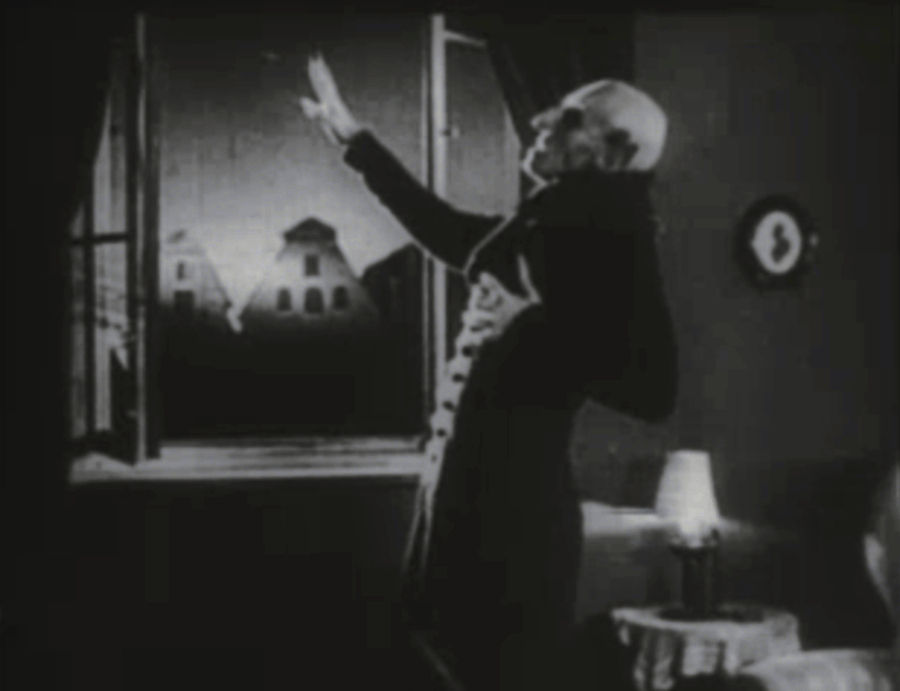
Vampires' aversion to sunlight originated much later than the rest of the vampiric protection folklore. The first occurrence of sunlight vanquishing vampires was in the silent movie Nosferatu (1922). Count Orlok, the creepy vampire with long nails, is killed by the rising rays of morning light because he had tarried too long draining blood from the pure Ellen, a woman with whom he was enamored. The sunlight became the metaphor for Easter, the resurrection of Christ—symbolic of purity and light defeating evil and darkness (Sebold, “How Nosferatu Rewrote the Rules of Vampires”).
From the decades following 1922, vampire portrayals in popular media in books, TV, and films progressively adopted this sunlight-death trope. In stark contrast, regional folklore was unaffected by this sunlight aversion in their vampire stories. Strigoi, vrykolakes, upyri, and other regional vampires preferred to operate at night out of convenience, not out of necessity like their popular media cousins.

Burial rituals to stop vampiric activities included:
Placing thorny branches or heavy rocks on top of the graves
Burying the body face-down
Binding the body limbs and tying the jaw shut or pinning the body down with stakes
Driving a stake through the corpse's heart
Removing the heart and burning it
Decapitation of the body
Burning the corpse altogether
Fire was the ultimate and implied method to totally destroy vampires
Extensive historical documentation exist attesting to people exhuming dead bodies suspected of vampirism and applying these burial rituals as early as the 11th century in Russia and the 12th century in England. Writer Paul Barber notes that the English accounts of revenant vampires show similarities to the Eastern European strigoi folklore of corpses reanimating to torment or kill off family (due to a sinful life, having an improper burial, or being born with "defects"), and staking the corpse, decapitation, covering the corpse with rocks, cremation, etc. as cures for vampirism (Barber, pp. 29-36, 158-164).
These burial practices are documented in exhumations recorded as late as 2004 ("Family exhumes 'vampire' relative," UPI). See PBS video "Secrets of the Dead."
Significant archaeological evidence also exists for these burial practices occurring even before the 11th century in Europe and North America—e.g., iron stakes driven through hearts, decapitated skeletons with heads placed between the legs or the feet, bricks or stones wedged into the mouth, and heavy rocks pinning down limbs or the torso.
Role of Vlad the Impaler and Bram Stoker

Vlad III (1431-1477), commonly known as Vlad the Impaler, is purported to be the historical figure upon whom the vampire, Count Dracula, is based (McNally and Florescu, p. 20). Dracula is the villain from the novel Dracula, written by Irish author Bram Stoker in 1897. Stoker researched Eastern European folklore, geography, and the history of Vlad III for his story. He authored several other novels, but his vampire novel became posthumuously popular, giving us one of the most feared and enduring villains in history.
Readers of the novel are given an aristocratic styling of vampires through the mysterious villain Dracula (dracul means dragon or devil in Romanian) with an impressive pedigree. He's a Transylvanian count with an ancient noble lineage, traced to Attila the Hun and Wallachian/Szekely warrior lines. With his hypnotic eye powers and sex appeal, the count preyed on virginal women in their bedroom. Dracula's behavior had sexual undertones that were taboo in the repressive Victorian age in which Stoker operated—obviously, the novelist injected sensationalism to sell the book.
Readers also received an indoctrination to vampire rules and weaknesses, which Stoker amassed from his folklore research: vampires being repelled by garlic and crucifixes, vampires' transmutation into bats, vampires not being able to enter uninvited, vampires needing to sleep on dirt from their homeland, mirrors not showing vampires' reflections, and killing vampires by driving stakes through their hearts.

Stoker promoted the concept of transmission of vampirism through an infectious bite from a vampire. He further popularized the location trope of the vampire's hidden abode: high up in the treacherous Carpathian mountains in Transylvania, where Dracula could remain in his secluded castle.
So, how does Vlad fit into the picture? Read on.
Vlad was the Prince of Wallachia, a historical region in southern Romania, ruling in three separate reigns during a turbulent period marked by fierce warring with the Ottoman Turks and regional disputes. His father was Vlad II, belonging to the Order of the Dragon ("Ordul Dracului"), a chivalric order fighting the Ottoman Turks. Vlad III inherited from his father the name, Dracula, meaning "the son of Dracul."
Vlad's preferred method of execution for criminals, enemies, Turks, and political rivals was impalement on wooden stakes. Chronicles attest that he held mass executions on the scale of thousands at a time. So, he received the worthy nickname, Vlad the Impaler.
Does this suggest that Dracula was the Prince of Wallachia first, before he became the Prince of Darkness?
To his credit, Vlad did not have any vampiric folklore surrounding him at all. Any associations with blood was through the bloodiness and gore of his executions—Vlad's brutality at his worst. As far as history is concerned, Vlad III was a competent leader—just not a leader you'd want to cross and have his preferred punishment carried out on you.

No where in the Stoker's Dracula novel itself does it identify Dracula as the Romanian prince. Evidence suggests the author wasn't too familiar with Vlad's history and merely used Dracula as a surname for his villain because of the term's meaning in Wallachian for a devil or a person with notable courage, cunning, and cruelty (Wilkinson, W., p. 19).
However, historians Raymond T. McNally and Radu Floresc, whose joint book In Search of Dracula (1972), promoted the link between Stoker's Dracula and Vlad III. From that point in time and on, modern media repeated and popularized the link between the two figures and ingrained it in pop culture.
As a side note, Stoker was influenced by an earlier vampire novel titled The Vampyre (1819) by John Williams Polidori. Polidori originated the aristocratic vampire archetype contained in Lord Ruthven, almost 80 years before Stoker worked on his antagonist character Dracula. Lord Ruthven is the dashingly handsome albeit morally-bankrupt aristocrat who corrupts young and virtuous women—a thinly-disguised jab at Polidori's patient, the Lord Byron. Lord Byron—full name was George Gordon Byron, 6th Baron Byron—had cruelly dismissed Polidori as his personal physician, and the doctor wanted to exact literary revenge on the lord through the novel.
Role of Death and Disease in Vampire Folklore

In Eastern European folklore, vampires were always connected with death and disease. Death itself was seen as a potential gateway for vampirism. People who are destined to become vampires had to die first and then through supernatural means, return to a state of appearing alive but are actually undead—they are immortal shells of the person they once were. These undead creatures would prey on the living, feeding on their blood to sustain their own unnatural existence.

Some tales suggested that a person could become a vampire by dying in a state of great turmoil, being buried alive, dying in unbaptized condition, or being excommunicated—"bad death" scenario.
Disease was another important aspect of vampire folklore. Plagues and epidemics were often blamed on vampiric activity. Vampires were believed to be vectors for deadly sicknesses such as tuberculosis, smallpox, or the Black Death. These undead creatures were believed to roam the countryside, spreading plague and panic through the villages. By linking vampires to death and disease, Eastern European cultures created a macabre folklore continuing to fascinate us today.
Connections with Witches and Werewolves

In various cultures and mythologies, vampires, witches, and werewolves all share a common thread—they're associated with supernatural powers, magical abilities, and a connection to the darkness. An individual who was marked or died improperly had greater chances of becoming one of these creature types.
These creatures often shared a "bad death" aspect or specific characteristics about their origins:
1. People who died an improper death—from suicide, excommunication, unbaptized state, execution, or great turmoil.
2. People born with strange signs that "marked" them, like with a caul, extra teeth, extra fingers or toes, tail, or born feet-first.
Witches often have a synergistic relationship with vampires, using their magic to transform into a vampire or to control them. In Romanian folklore, some witches were believed to be "living vampires" (strigoi vii), in that they had dark magic and drained the life force out of their neighbors and livestock. And when these witches died, they would go on to become the undead vampire (strigoi morti).
Romanian folklore also had the aforementioned class of pricolici creatures—vampires able to shapeshift to werewolves at night—blurring the lines between species. They are similar to the Slavic vukodlak, a term used interchangeably for werewolves and vampires across the Balkans in Serbia, Bulgaria, Bosnia, and neighboring regions. The vukodlak vampires become wolves at nightttime, prowling the countryside and preying on human victims and livestock.
Dr. Juliette Wood, a historian, had these remarks about the connections between vampires and wolves: "Vampires and werewolves are liminal beings, existing between life and death, tied to night and burial grounds. Both reflect fears of the dark and the unknown. Neither chooses their fate; they're trapped between worlds, cursed, dangerous, and beyond human control" ("Historian Answers Folklore Questions," Wired, time stamp 6:43+). Sometimes people are cursed to become these monsters—who can't die—because of their family's activities, according to Dr. Wood.
The folklore of these creatures are tied to society's fears of unusual and unexplained harsh events that are thrust upon it, as is in plague outbreaks or mysterious deaths. These creatures demonstrate cultures' fear of the darkness and the "nightmare world," says Dr. Wood. When horrible events occur, we would rather have something or someone tangible to place blame upon than nothing at all.
Global Perspectives of Vampire Mythology
Across every continent, the vampire reappears in different guises. The same familiar themes: Death might not be final. Someone we love could return to haunt us—changed, hungry, and dangerous.

In China, mythology warns of the fearsome jiangshi ("stiff corpse"), a vampiric creature dressed in period costume from the Qing Dynasty. A jiangshi hops or leaps to move around due to its rigid limbs; it drains life essence called qi from people, rather than blood. The jiangshi doesn't suck the qi from victims through a bite—it drains qi from the victim's breathing. Depending on the amount of qi taken, victims are left severely weakened or dead from an encounter with this creature. There are some regional variant folklore warning that victims who don't die from a jiangshi attack, could later become one themselves—spreading the affliction like an infection.
Indians have vampire-like mythology involving the vetala, who are mischievous spirits inhabiting corpses, and rakshasas, who are shapeshifting demons that consume human flesh and blood.

In Thailand, we have the iconic Krasue (กระสือ), a vampiric creature with a distressing backstory and appearance: by day, the krasue is a woman. By night, she detaches her head along with intestinal organs from her body—her floating head and dangling entrails, which glows (yikes!), seek out victims and livestock for raw meat and blood as sustenance.
One version of the krasue's origin is summarized in this tragic account: the krasue was once was a princess betrothed to a Siamese nobleman. She fell in love with a lower class man, however, and when she was found out, the princess was sentenced to death by burning. She turned to witchcraft to survive the burning, but her spell was enacted too late. Only her head, neck, and attached organs were shielded from the flames. She was cursed to go on "living" in this form, feeding at night on raw meat and blood.
Several other Southeast Asian countries, have their own brand of the krasue creature with regional names: the Penanggalan (Malaysia), Manananggal (Philippines), Ahp (Cambodia), Kasu (Laos), Kuyang (Indonesia), and Ma Cà Rồng (Vietnam)—all shared the detached-head, trailing-organs motif.

In the Philippines, people greatly feared the Aswang—an umbrella term for shapeshifting monsters with traits that are shared among vampires, werewolves, ghouls, and witches. By day, the aswang may be an everyday villager. But by night, it transforms into a monster with its long, tube-like tongue, capable of sucking blood from, in particular, children, fetuses, and the sick.
Vampire mythology in Africa offers the Adze of West African (Ewe) folklore. The adze is a firefly-like spirit that transforms into human form to feed on blood. The Asanbosam is a tree-dwelling vampire with iron teeth and hooked feet.

In Australia, the vampiric folklore comes from the southeastern Aboriginal culture. The Yara-ma-yha-who is a small red frog-like man, standing about 4 feet tall, with an large head, wide mouth without teeth, and suckers on its fingers and toes. It lives in fig trees, lurking within the branches.
When the yara-ma-yha-who senses a nearby victim, it drops onto him. Then it drains his blood with its suckered fingers and feet, and proceeds to gobble the victim up completely with its widely-stretchable mouth—like a python swallows its prey: head-first. The yara-ma-yha-who later vomits the victim up alive but as a redder and smaller version. If the same victim doesn't run away but is caught by the creature and swallowed multiple times again, the victim himself becomes a yara-ma-yha-who. Unlike European vampires, the yara-ma-yha-who is a living vampiric creature, not reanimated or undead (“Yara-ma-yha-who: Australia’s Regurgitating, Blood-Sucking Monster | Monstrum” video, 2012).
In North America, the indigenous cultures have no single vampiric figure. However, tribal folklore about three creatures with vampiric traits are worth noting: the Wendigo (Algonquian), a cannibalistic spirit linked to greed and starvation; the Skadegamutc (Wabanaki), an undead sorcerer who drinks blood and flesh at night; and the Rolling Head (Iroquois/Woodland tribes), an undead disembodied head seeking revenge.
Modern Cultural Significance
In today's world, vampires endure without end, just like their mythology tells, because of their adaptability as characters, their ability to be portrayed as outsiders, and the commercial appeal of the romantic vampire trope.
Gentler, More Morally-Conflicted Versions

Through the years, vampires have evolved from being restless, monstrous spirits who rise from the dead to terrorize their families, to being seductive aristocrats who lure victims with charm and sex appeal, only to also drain their victims' blood. These charismatic creatures sometimes shapeshifted into other animals, such as werewolves or bats, as needed.

Today, we further morph the vampire archetype to portray them as misunderstood individuals with unusual handicaps—their hunger for blood, allergy to sunlight and garlic, and other vampiric traits—as outsiders not readily welcomed into mainstream society. Modern vampires often have reluctant natures, constantly grappling with the moral dilemma of killing a person for survival. There is a tinge of tragedy in their cursed fate as immortal beings.

Vampiric mythology heavily inspired the gothic subculture (or "goth" for short), which started in the U.K. during 1970s-1980s. The goth subculture, bolstered by strong interest in post-punk gothic rock (as in the music of the Bauhaus, Siouxsie, Banshees, and the Cure), saw adherents studying and promoting the virtues of Victorian- and Edwardian-period literature, fashion, and architecture. People "into" goth often dyed their hair black and wore heavy makeup with white foundation, dark eyeliner/eye shadow, and blood red lips. They often wore dark clothes, sometimes 19th-century-inspired fashion.
Anne Rice's popular book series The Vampire Chronicles (1976-2018) provided a modern take on vampire lore. In the first installment, Interview with the Vampire, we have the sensitive, morally-anguished Louis de Pointe du Lac and the bold, multi-talented Lestat, who aren't outright villains. This vampire duo, with lightly-touched upon homosexual undertones, are embroiled in a tragic story with the child vampire Claudia in New Orleans around the late 18th century.
Commercial Appeal
No doubt the popularity of vampires is demonstrated through their marketable presence
in modern media. These media narratives have been readily assimilated into pop culture. In literature, we have Salem's Lot (1975) by Stephen King, the aforementioned Vampire Chronicles by Anne Rice, Twilight series (2005-2008) by Stephanie Meyer, which inspired several wildly-popular movie installments, The Vampire Diaries series (1991) by L.J. Smith, The Passage (2010) by Justin Cronin, and A Discovery of Witches (2011) by Deborah Harkness.
In the world of TV, we have: Buffy the Vampire Slayer (1997–2003), True Blood (2008–2014), The Vampire Diaries (2009–2017), Penny Dreadful (2014–2016), Midnight Mass (2021), and What We Do In the Shadows (2019–2024), among many others.

In cinema, we are given Nosferatu (1922), Dracula (1931), The Return of the Vampire (1943), Dracula: Prince of Darkness (1966), The Lost Boys (1987), Bram Stoker's Dracula (1992), Buffy the Vampire Slayer (1994), Interview with the Vampire (1994), From Dusk to Dawn (1996), Blade (1998), Underworld (2003), Let the Right One In (2013), What We Do In Shadows (2014), and Sinners (2025), among the numerous vampire films of note.
I can attest to suffering many sleepless nights from watching a scene as a kid from the TV mini-series Salem's Lot (1979) based on the legendary Stephen King's novel: one fateful night a vampire boy in pajamas—newly risen from the dead—floated to the window of his brother's bedroom. I clearly remember the vampire boy hovering at the window with his evil whitish eyes, fanged smile, and the scratching of his nails on the window to wake his brother from bed. How can I possibly forget the grating noise of his vampire nails on the glass pane? The unsuspecting brother, of course, went to the window and opened it. Alas, the vampire boy was let in to do the deed. This scene is the definition of trauma for me—for years to come.
I would "sleep" those nights with the bedcovers wrapped around my neck and most of my face—even though sometimes it was suffocatingly warm—in my feeble attempts not to expose my neck to vampire bites. I didn't care for the romantic side of vampires; the dangerous biting side was the one of immediate concern.
Remarks on Enduring Legacy

From their origins as Mesopotamian demonesses Lamashtu and Lamia—precursors to the modern concept of vampires—these creatures have been blamed for inexplicable societal ills throughout history. In medieval times and on, they took on monstrous forms, fueling superstitious and fearsome folklore about striges and strigoi.
As medical and scientific knowledge have advanced, and sanitation practices have improved, the vampiric folklore has undergone a significant transformation. Once feared and reviled, vampires are now frequently depicted in sympathetic and romanticized portrayals, reflecting the changing cultural perspectives and attitudes that accompany greater understanding.
Even with these archetypal modifications, vampires remain an enduring fixture in modern-day folklore and fascination. The Halloween season is known for their resurgence in popularity, as their dark mystique and richly layered tropes of seduction and romance continue to captivate audiences. It's precisely this paradox—the incongruence of sexual appeal and gruesome murder—that underscores what truly sets vampires apart: their tenacious immortality.
By Mel Bridges
References
Anonymous, "Family exhumes 'vampire' relative," UPI, Feb 26, 2004. https://www.upi.com/Odd_News/2004/02/26/Family-exhumes-vampire-relative/84711077817552/
Barber, Paul. Vampires, Burial, and Death: Folklore and Reality. Yale University Press, 1988.
Black, Jeremy and Green, Anthony. Gods, Demons and Symbols of Ancient Mesopotamia: An Illustrated Dictionary, British Museum Press, 1992.
Guilhou, Nadine. “Myth of the Heavenly Cow,” UCLA Encyclopedia of Egyptology, Aug 12, 2010. https://escholarship.org/content/qt2vh551hn/qt2vh551hn.pdf
Liberalis, Antoninus. Metamorphōseōn synagōgē. Antonini Liberalis Transformationum congeries. Abrahamus Berkelius emendavit, National Library of Naples, 1676. https://archive.org/details/bub_gb_KHrksHQ7rewC/page/n5/mode/2up
Masters, Robert. The Goddess Sekhmet: The Way of the Five Bodies, Amity House, 1988.
McNally, Raymond T. and Florescu, Radu. In Search of Dracula; A True History of Dracula and Vampire Legends, 1972. https://archive.org/details/insearchofdracul00raym
Lawson, John C. Modern Greek Folklore and Ancient Greek Religion, Cambridge University Press, 1910. https://www.gutenberg.org/files/66116/66116-h/66116-h.htm
Parikh, Amee. “Sekhmet: Egypt’s Forgotten Esoteric Goddess,” History Cooperative, Aug 12, 2024. https://historycooperative.org/sekhmet/
Pinch, Geraldine. Egyptian Mythology, A Guide to the Gods, Goddesses, and Traditions of Ancient Egypt, Oxford University Press, 2002.
Said, Miriam. “Mesopotamian Magic in the First Millennium B.C.” In Heilbrunn Timeline of Art History, New York: The Metropolitan Museum of Art, Dec 2018. http://www.metmuseum.org/toah/hd/magic/hd_magic.htm,
Sebold, Witney. “How Nosferatu Rewrote the Rules of Vampires,” SlashFilm, Aug 9, 2022. https://www.slashfilm.com/807267/how-nosferatu-rewrote-the-rules-of-vampires/
Wiggermann, Frans A. M., “Chapter X: Lamashtu, daughter of Anu, A Profile,” Birth In Babylonia and The Bible, Styx Publications, Groningen, 2000. https://archive.org/stream/LamashtuDaughterOfAnu/WiggermannLamashtu_djvu.txt
Wilkinson, Richard H. The Complete Gods and Goddesses of Ancient Egypt, Thames & Hudson, 2003. https://archive.org/details/TheCompleteGodsAndGoddessesOfAncientEgypt/The%20Complete%20Gods%20and%20Goddesses%20of%20Ancient%20Egypt/page/n181/mode/2up?q=sekhmet
Wilkinson, William. An Account of the Principalities of Wallachia and Moldavia: With Various Political Observations Relating to Them. London: Longman, Hurst, Rees, Orme, and Brown, 1820. https://www.gutenberg.org/cache/epub/68612/pg68612-images.html
VIDEOS
“Historian Answers Folklore Questions | Tech Support | WIRED,” Wired Channel, June 2025. https://youtu.be/i61jkjPtMuw.
"Secrets of the Dead," Season 15, Episode 1, PBS, Oct 27, 2015. https://www.pbs.org/video/secrets-dead-vampire-slaying-ritual-romania/
“Vampires: A Brief History of Obsession - (Exploring Vampire Folklore),” Mythology & Fiction Explained Channel, 2025. https://youtu.be/dwrmV68ZnfM
"Vampires: Origins and Real History," Fortress of Lugh, Oct 26, 2021. https://youtu.be/Bq5_2zoX-AM?si=RZHevetumvKW0Cp8
“Yara-ma-yha-who: Australia’s Regurgitating, Blood-Sucking Monster | Monstrum,” Storied, 2021. https://youtu.be/7ZhrOnxbccY


Comments