


The Saga of the Pangboche Hand: Yeti Hoax or Genuine Artifact?
Updated: Aug 5
An important relic supporting the existence of the Yeti, the Pangboche Hand, has proven fascinating and controversial. Kept safe along with other sacred relics within the coffers of the Pangboche monastery in Nepal, the Yeti hand bones had endured for many centuries.
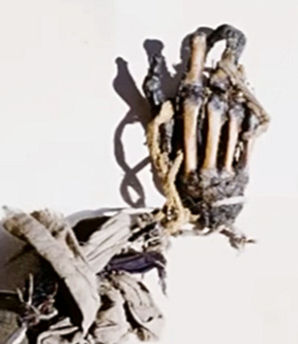
The hand bones are elongated, heavy, and squarish with long fingernails at the end. The bones are partially covered by dark, crusty skin and appear oily, probably due to exposure to temple candles and lamp oil. The bones are crudely wired together. Some accounts maintain that the hand bone size are similar to humans, and others say the size is twice that of humans.
We take a deep dive into the tale of how the Pangboche Hand was stolen by Westerners through trickery and deception, leading to a setback on Yeti research for many years. Recent developments on the Pangboche Hand have gained renewed interest in the Yeti.
Origins of the Pangboche Hand

According to Nepalese legend, on a snowy day a 17th century Tibetan monk named Lama Sangwa Dorje entered a cave to meditate. As he sat in contemplation, a Yeti emerged from the shadows. The curious creature was drawn to Sangwa and began to revere the meditating monk. The benign Yeti took care of Sangwa by regularly bringing him offerings of food, water, and fuel. Over time, the Yeti became Sangwa's devoted disciple, learning from the wise monk. (1)
When the Yeti's life ended, Sangwa collected its hand and scalp as sacred relics. With reverence, he carried these treasures back to the Pangboche monastery, where they were enshrined alongside other honored artifacts. From that day forward as occasion arrived, the Yeti scalp was paraded around the village as a fertility ritual to "bless the people, animals, houses, and fields." (1)
Visitors from the West heard of this hand and had to investigate.
Where There's A Will, There's A Way

Tom Slick, an oil millionaire from Texas, had an intense interest in cryptozoology. He funded several expeditions during the late 1950s to the Himalayan mountains to find the Yeti. On one of these trips, the businessman heard rumors of the Yeti hand in Nepal and searched for it. Finding the hand at the Pangboche monastery, Slick's expeditionary team took photos of the hand bones and introduced these images to the West. (2, 3)
Slick's team wanted to bring the Pangboche Hand back to the West for scientific study. But the team's requests were denied—the Buddhist monks angrily refused. (4) The monks feared removing these bone relics would bring bad luck and disaster to their temple. (4, 5)
Taking Matters into Their Own Hands

Peter Byrne, a fellow explorer and member of Slick's later expeditions, played a major role in the smuggling of one of the bones in the Pangboche Hand. He was sensitive to preserving the Nepalese cultural traditions, up to a certain point. When Byrne was in London, he discussed the Pangboche Hand with Primatology Professor William Osman Hill. Professor Hill adamantly told Byrne the hand needed to be examined. (5)
As the story goes, Byrne went on another Nepal expedition with the express instructions from Professor Hill and Tom Slick, to extract at least one finger bone from the Pangboche Hand. (4) At the monastery in Nepal, Byrne waited until the monks watching the sanctuary were sleeping and withdrew the Pangboche Hand from its vault. He then removed "a thumb, a phalanx, and skin from two locations" and switched the bones in the hand with human finger bones (provided by Professor Hill), which he strung back up and rewrapped. (4, 6)
There is an alternative tale of how Byrne obtained the Yeti finger bone, which is more mundane and probably closer to the truth. Byrne negotiated with the Nepalese monks for a finger to be removed from the Pangboche Hand, in exchange for a donation of 10,000 rupees, which was sizeable back in the day. (7) He then replaced the finger with human finger bones and wired them back into the hand.
The Hollywood Connection

Byrne schemed with actor James Stewart, a fellow Yeti enthusiast, to complete the rest of the heist. Stewart had his wife Gloria hide the Yeti finger bone in her suitcase within her lingerie. Back in the day, British customs officers did not search through ladies' underwear, as it wasn't gentlemanly to do so. Byrnes and Stewart managed to extract the bone safely out of Nepal into India. (6, 7)
Byrne brought the Yeti bone to London University, where it was examined by Professor Hill. The professor's initial finding was that the bone's origin was from a hominid. Other consultants cast doubt on that observation. Anthropologist George Agogino noted that the metacarpals were "very flat" and "highly characteristic of giant anthropoids." Another anthropologist, Stanley Garn, wrote that the "relative lengths... of the metacarpals is somewhat out of order for the normal man." (8)
Later in 1960, Professor Hill changed his mind and observed the bone was closer to that of a Neanderthal. (3, 8) All these findings were promising, warranting further study with modern technology.
The heist details involving Slick, Byrne, and the Stewarts were confirmed by cryptozoologist writer Loren Coleman while researching the archives of Tom Slick and Peter Byrne and through a personal letter from James Stewart. Coleman wrote the biography of Tom Slick in 1989. (9)
Yeti Legend: Debunked by Famous Mountaineer

Unfortunately, soon after the hand theft, Sir Edmund Hillary led his Silver Hut expedition, officially named The World Book 1960 Scientific Expedition to the Himalayas, to collect evidence of the Yeti. Hillary was a skeptic about Yetis and treated the creature more as a marketing ploy to fund his mountain expeditions. (10)
Hillary travelled to remote temples and gathered several relics: scalps and bone fragments—among them, of course, was the Pangboche Hand. The famed mountaineer, who scaled Mount Everest, had no idea at the time of the tampering of the Yeti hand by Peter Byrne.
Hillary identified through scientific examination that the hand bone was human in origin, and the other relics came from known animals. (11) The Pangboche Hand was "a large but slender hand, a woman's perhaps, but more possibly a young lama's." (12) For a long time, the Yeti legend was debunked by Hillary's findings.
Assistance From a TV Show
In 1991, Anthropologist George Agogino was found to have kept fragments of the Pangboche Hand. Agogino was a consultant to Slick for his Himalayas expeditions. The TV show Unsolved Mysteries acquired a sample of the bones for DNA analysis. The show verified the specimen to be "near human," sharing a similarity to human, and did not match any known primate at the time. (4) But no other definitive conclusion could be made.
Sadly, the entire Pangboche Hand and the accompanying scalp were stolen from the Pangboche monastery shortly after the TV show aired. The continued theft makes it extremely difficult to perform further studies, thereby muddying the waters on evidence of the Yeti.
The Return of the Replicas
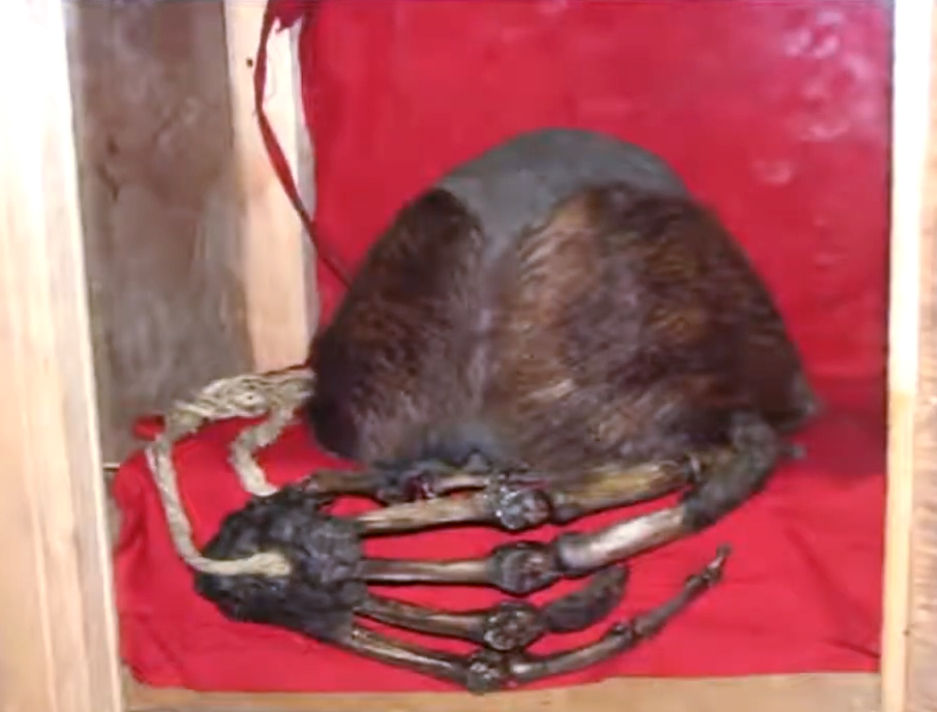
Mike Allsop, a New Zealand pilot and mountaineer, (5) heard about the plight of the Pangboche monastery in 2011. Allsop asked Weta Workshops, the special effects studio that made the models for The Lord of the Rings movies, for assistance. The workshop agreed to make a replica of the Pangboche Hand and Skull for free. (13)
The replica was delivered to the Pangboche monastery by Allsop himself. He hoped the monastery would benefit from the income given by tourists who'd travel to see the relics in person. (7, 13)
Recent Developments

Also in 2011, the Zoological Society of Scotland at Edinburgh Zoo obtained a bone specimen from the actual finger bone smuggled from the Pangboche monastery about 50 years back. The stolen bone fragments are now kept in the Hunterian Museum of the Royal College of Surgeons in London, bequeathed by Primatologist William Osman Hill in 1975. (5)
A DNA analysis performed by Dr. Robert Ogden concluded that the bone specimen matched "existing human DNA sequences" for people from the regions of China and Asia. So, for the time being, the Pangboche Hand has once again been proven to be a hoax by the Scottish study. (14)
Case closed? Not yet. Cross-contamination concerns in the Pangboche Hand bones in recent DNA-analysis studies are brought up in the video, The Yeti Isn’t an Animal…And the Sherpa Have the Proof, Part 5: The DNA Problem, timestamp 32:32. (15)
Watch YouTube video, The Yeti Isn't an Animal...
Concluding Remarks
The debunking of a famous relic does not disprove the legend of the Yeti. For believers, it is merely a setback in the search for more scientific evidence to support belief in the iconic snowman.
Moreover, it is known that Buddhist monks in Nepalese monasteries sometimes fabricated relics and allowed them to be considered sacred because of their importance in festivals. Due to rivalry between the Sherpa villages, the villagers gave authority to these relics, which sometimes aren't the real thing. (2)
In the case of another set of Yeti hand and arm bones found at Makalu, Tom Slick's team quickly found that they were from a snow leopard. (2) When Edmund Hillary studied the Pangboche Hand bones, they were obviously mishandled from Peter Byrne's involvement. It is next to impossible to know if researchers later examined the Yeti or human part of the Pangboche Hand. (16)
For now, Yeti stories are repeated among the many peoples of the Himalayan cultures. Belief in the metoh kangmi (Sherpa for "wild man-bear of the snows") is still solid and persistent despite the lack of concrete scientific evidence.
— By Mel Bridges
References
Caper, Daniel. “The Friendly Yeti,” Journal for the Study of Religion, Nature and Culture, 2012, pp. 79-80.
Coleman, Loren. Tom Slick and the Search for the Yeti, Faber and Faber, Boston, c. 1989, pp. 78-79.
Coleman, Loren. "Pangboche Yeti Finger In Context: What Does Human Mean?", Cryptozoonews, Dec 28, 2011. http://www.cryptozoonews.com/pangboche-dna2/
Hale, Rick. "The Pangboche Hand," Supernatural Magazine, https://supernaturalmagazine.com/articles/the-pangboche-hand
"Tracing the origins of the 'yeti finger,'" BBC News, Dec 27, 2011, https://www.bbc.com/news/science-environment-16264752
Coleman. Tom Slick and the Search for the Yeti, p. 90-91, 99.
Fugleberg, Jeremy. "The Strange Saga of the Stolen Yeti Hand," Atlas Obscura, May 29, 2013. https://www.atlasobscura.com/articles/saga-of-the-yeti-hand
Coleman. Tom Slick and the Search for the Yeti, p. 91.
Ibid, p. 79, 91-92.
Ibid, p. 94-95.
Ibid, p. 96-99.
Hillary, Edmund and Doig, Desmond. High in the Thin Cold Air, Doubleday, c. 1962, p. 77.
Jolly, Joanna. "'Yeti hand' replica to be returned to Nepal monastery," BBC News, April 28, 2011. https://www.bbc.co.uk/news/world-south-asia-13228780
Radford, Benjamin. “Infamous 'Yeti Finger' Flunks DNA Test,” NBC News, Dec 28, 2011. https://www.nbcnews.com/id/wbna45810739
"The Yeti Isn’t an Animal…And the Sherpa Have the Proof" video, The Cabin in the Woods, May 2026, https://www.youtube.com/watch?v=suMaFLmYCNg
Coleman. Tom Slick and the Search for the Yeti, p. 92.

Comments