


Mythical Creatures: Origins and Legends of the Enigmatic Unicorn
Updated: Sep 5
Unicorns conjure up fantastical tales in magical lands involving knights on quests, miraculous healing through their horns, and the menacing nature of the single-horned beast. This creature has been an iconic symbol of purity, grace, and divinity, enchanting people for centuries.
The mythical unicorn has appeared in a range of cultures and stories, creating a rich history that raises an interesting question: What is the true story behind the creature? Join us as we explore its origins and legends, revealing the themes and symbolism that make the unicorn so captivating.
A Glimpse into Ancient Origins of Unicorns

The fascination with unicorns dates back to ancient civilizations, with some of the earliest mentions appearing in the Indus Valley civilization around 2500 BCE during the Bronze Age. Found in this civilization are artifacts called unicorn seals featuring a creature resembling a unicorn with a bovine-like torso, suggesting that this symbol was already significant in those times.
During excavations of the Harappan urban centers (named after the excavation site at Harappa in now Punjab, Pakistan), hundreds of these square-shaped unicorn seals were unearthed. These square seals served as symbols of ownership and social standing.
Various theories have emerged to explain the identity of this enigmatic creature. Some propose that it may be an image of the extinct aurochs, while others suggest it could be an antelope. These differing interpretations highlight the complexity and richness of the Indus Valley Civilization's artistic expression. Read more at: https://www.deccanherald.com/features/art-and-culture/unicorn-seals-an-enduring-mystery-2812607.

The Greeks played a crucial role in spreading the unicorn myth. The earliest written records of unicorns come from historian Ctesias' book Indika, where he vividly describes them as speedy wild asses with a majestic horn measuring nearly 28 inches in length. This fantastical creature was said to boast a striking coat of white, red, and black hues. But don't bother trying their meat—it's reportedly too bitter to stomach. Interestingly, Ctesias likely drew inspiration from his time living in Persia, where winged bulls and lions battling a single-horned animal were depicted in ancient reliefs at Persepolis, the Persian capital.

This account helped shape how unicorns were later portrayed in Western traditions. Philosopher Aristotle later built upon Ctesias' work, referencing two one-horned animals: the oryx (a type of antelope) and the "Indian ass."
In a fascinating case of mythological convergence, the oryx's striking horns—with their menacing yet elegant curves—have led to its association with the legendary unicorn. When viewed from the side, the oryx's two horns merge into a singular, majestic shape, sparking an uncanny resemblance to its mythical counterpart. This remarkable similarity was noted by historians like Aristotle and Pliny the Elder, who saw the oryx as the very prototype of the unicorn. (1) Sadly the Arabian oryx was extinct in the wild by the 1970s. It was, however, saved in zoos and re-introduced in the 1980s.
Unicorn Symbolism Across Cultures
Unicorns symbolize more than mere beauty; they embody a complex set of meanings across cultures. In Western traditions, unicorns are often associated with purity and innocence. Literature from the medieval period frequently depicts them with a virgin maiden, reinforcing their divine connection.

Unicorns in Eastern traditions, particularly in Chinese mythology, take on a slightly different meaning. In China, the unicorn is known as the qilin, symbolizing prosperity, harmony, and the arrival of wise leaders. The qilin is first mentioned in ancient Chinese poetry, specifically in the "Feet of the Lin" (Lín zhī zhǐ ) section of the revered Classic of Poetry (11th-7th century BCE). But it was in the Spring and Autumn Annals that we find a recorded sighting: a qilin was allegedly captured in 481 CE, during the reign of Duke Ai of Lu. Interestingly, the great Confucius himself is credited with identifying this enigmatic creature.

In Japan, the kirin is a mythical creature similar to the qilin. Kirin has also become the modern Japanese word for giraffe. Japanese art often depicts the kirin as a deer-like creature, but with some fascinating variations: it can be shown as a dragon-shaped deer with an ox's tail or even exhibit unicorn-like features, complete with a backwards-curving horn. his creature embodies the values of good fortune, prosperity, wisdom, morality, justice, and spiritual harmony.
In Korean mythology, the girin is another manifestation of the qilin. This majestic creature has a distinctive appearance: its torso resembles a deer's, while its hindquarters are said to have an ox's tail and horse hooves. Initially depicted as more deer-like, the girin evolved over time into more horse-like forms. As one of the four sacred creatures (along with the dragon, phoenix, and turtle), the girin played a significant role in Korean royal and Buddhist art.
Interestingly, just like Japanese speakers when using the word "kirin," Koreans use "girin" today to refer not only to mythical creatures but also to giraffes. Similarly to Chinese and Japanese culture, the Korean unicorn myth symbolizes purity, wisdom, kindness, peace, harmony, and prosperity.
Unicorns in Medieval Literature

During the Middle Ages, unicorns emerged as popular figures in bestiaries and works of literature where they were romanticized. Often portrayed as elusive creatures, capturing a unicorn was seen as a mark of great fortune.
The famous "The Hunt of the Unicorn" tapestries from the late 15th century illustrate this theme, depicting noble hunters in pursuit of the mythical creature. The majestic unicorn is depicted continually as being hunted, echoing themes of vulnerability and temptation reminiscent of both young maidens and the Passion of Christ. Each tapestry also represents metaphors of purity and truth, reinforcing the unicorn's symbolic weight.
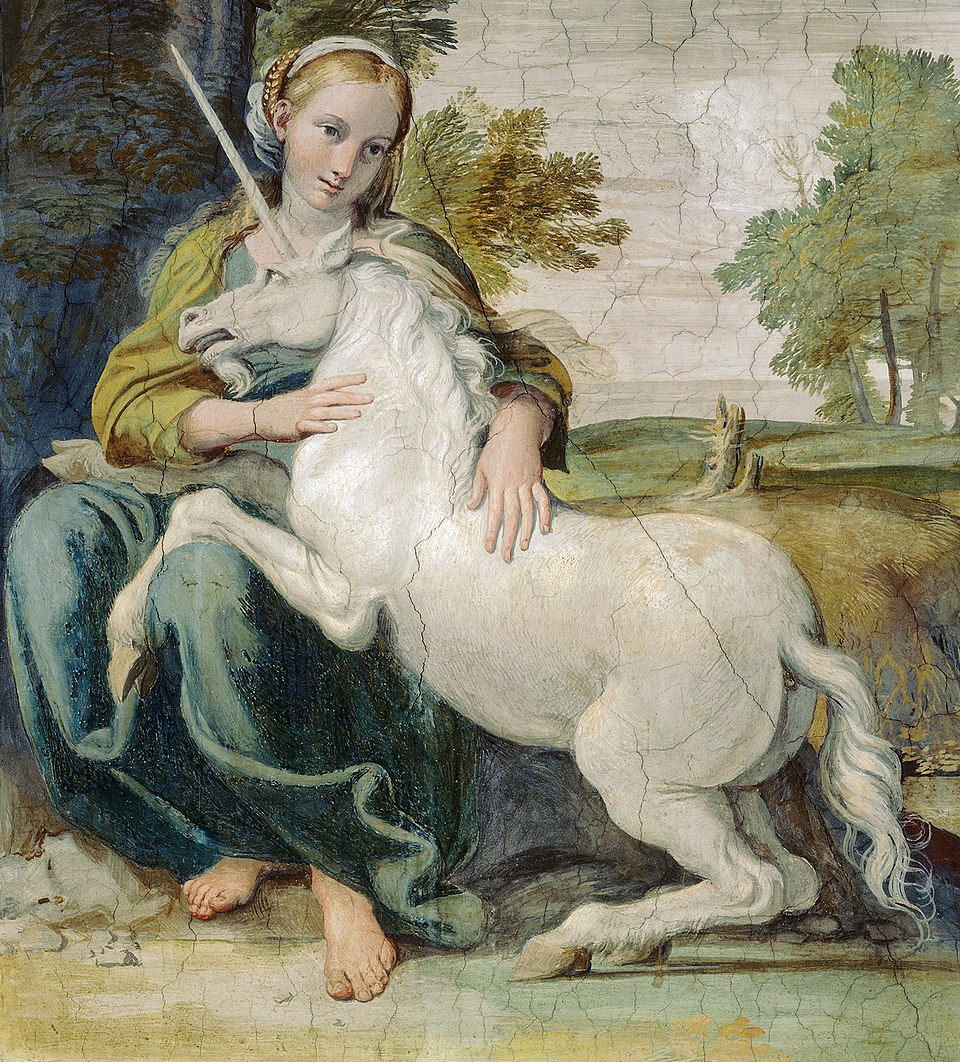
Writings like Physiologus, an early Christian text, described unicorns in relation to Christ. The writing is a rich allegory that prefigured the medieval bestiary tradition. The captivating tale features a maiden, symbolizing the Virgin Mary, trapping or taming a magical unicorn—representing the Incarnation itself. As soon as the unicorn lays eyes on its maiden-captor, it gently lowers its head onto her lap and succumbs to a peaceful slumber.
Depictions of a virgin with a unicorn became a common motif in medieval art and literature. This fantastical dynamic has been interpreted by some writers as an allegory for the special bond between Christ and the Virgin Mary.
Legends of Healing and Protection
One of the most captivating aspects of unicorn mythology lies in its association with healing and protection. The unicorn’s horn, often referred to as "alicorn," was believed to possess significant medicinal properties. In medieval Europe, powdered unicorn horn was thought to cure ailments such as fevers and infections, cleanse water, and even detect poison—claims that drew the interest of the wealthy elite.

This belief resulted in a booming, albeit fraudulent, market for unicorn horns, mainly sourced from narwhal tusks. These deceptions highlight humanity's enduring interest in exotic beasts and the exploitation of nature.
Modern Representations of the Unicorn

In contemporary culture, unicorns have experienced a resurgence, becoming symbols of whimsy and fantasy. They are widely featured in children's literature and pop culture. For example, films like "The Last Unicorn" and TV series such as "My Little Pony" present unicorns in cheerful, pastel colors and magical settings, appealing to our love for fantasy and imagination. Modern cultures view these mythical creatures as representing hope, adventure, magic, innocence, creativity, self-expression, and individuality.
Reflections

Examine the unicorn through history, and you're really exploring humanity's search for beauty, truth, and hope. From a symbol of purity in ancient texts to a whimsical icon in modern fantasy, the unicorn has always lived at the crossroads of fact and fable—part reality, part imagination.
Look closer at its origins, and a deeper story emerges: myth after myth casts the unicorn as a stand-in for our oldest struggle—good against evil, purity against greed.
Citation
Rich, M. (1994). The Archaeology of the Arabian Gulf c. 5000-323 BC, London: Routledge, p. 63-64.

Comments