


Mythical Creatures: Dive into the Legends and Origins of Mermaids
Updated: Sep 5

For centuries, mermaid tales have fascinated people around the world. From ancient sea-faring adventures to modern retellings, these exotic creatures—with the upper body of a woman and the tail of a fish—have inspired countless stories, songs, and works of art.
Have you ever wondered where mermaid legends first started? In this post, we explore the captivating history and mythology behind these mysterious beings, and how these myths have evolved over time. Their modern significance to society will also be considered.
Watch: The Dark Origins of Mermaids
Ancient Civilizations and Their Water Deities
Mermaids have roots in various ancient cultures, often tied to water deities and fertility. We'll explore the mermaid origins of several civilizations of old.
Mesopotamian

In Mesopotamia (~2600 BCE–200 BCE), there was a powerful deity named Enki, or Ea in Akkadian—the god of water, wisdom, and creation. Enki was closely linked to the Abzû, a freshwater ocean resembling a mystical underworld. Instead of being a fish-human hybrid, Enki is often depicted as a man with streams of water flowing from his shoulders or a vessel, like he was channeling the sea itself.

We have a real merman figure in the kulullû, or "fish-man," a part of Enki's court. In Mesopotamian art (~2000 BCE)—e.g. in talismanic clay figurines, dark boundary stones, and cylinder seals—the kulullû is depicted with a human upper body and the lower body of a fish. In later Assyrian mythology, the kulullû was associated with kuliltu, "fish-woman."
Another mythical merman of importance is Oannes, a divinely-appointed emissary of Enki, sent to teach mankind —the first and foremost of the apkallu—the "Seven Sages," (speculated time is pre-Flood era). The Babylonian priest Berossus described him as a creature with a fish body, human head, and feet underneath the fish tail. This merman-like creature emerged from the seas, bringing with him a wealth of knowledge. With his teachings, Oannes imparted the secrets of writing, temple building, mathematics, and how to plant seeds and harvest crops, to ordinary people, setting us on a path towards civilization as we know it today (Berossus, Babyloniaca, FGrH 680 F1b).
Syrian

In ancient Syria (~100 BCE-200 CE), a prominent mermaid-like creature is found in Atargatis, a fertility goddess whose main sanctuary is in Hierapolis, Syria. Along withher consort Hadad, Atargatis protected and maintained the health of her city.
According to Syrian mythology, Atargatis fell in love with a mortal shepherd but accidentally caused him to die. In great despair and guilt, she threw herself into a lake. She didn't drown but was instead transformed into a fish-like creature. But her transformation was not complete. Her divine beauty could not be fully concealed by the waters—her glorious looks prevented a full metamorphosis into a fish. Instead, she retained her beautiful face and upper woman's body with her lower body becoming a fish tail. Atargatis' love story serves as a foundational narrative, illustrating how deeply intertwined love and loss shapes mermaid mythology.
Greek

For the ancient Greeks, the mythology of sirens overlapped with that of mermaids. Sirens were bird-women creatures who inhabited an island near the southwestern coast of Italy. Ravishingly beautiful maidens with bewitching voices, their song lures sailors on sea vessels onto the rocks surrounding their island, where the men would die. According to Homer's Odyssey, Odysseus (Ulysses) was forced to resist their enchantment by having his crew plug their ears with wax and tie him to the mast of the ship.

Homer's Odyssey is suspiciously silent about the sirens' actual appearance. It is through the sirens' depiction in Greek art as bird-women—having a bird body with a woman's head—are we clued in on what they look like. At the British Museum in London, famous "siren vases" are displayed, showing a scene from the Odyssey in which Odysseus is tied to the mast of his ship, and sirens are at work, trying to lure him and his sailors off their ship with their enchanting birdsong.
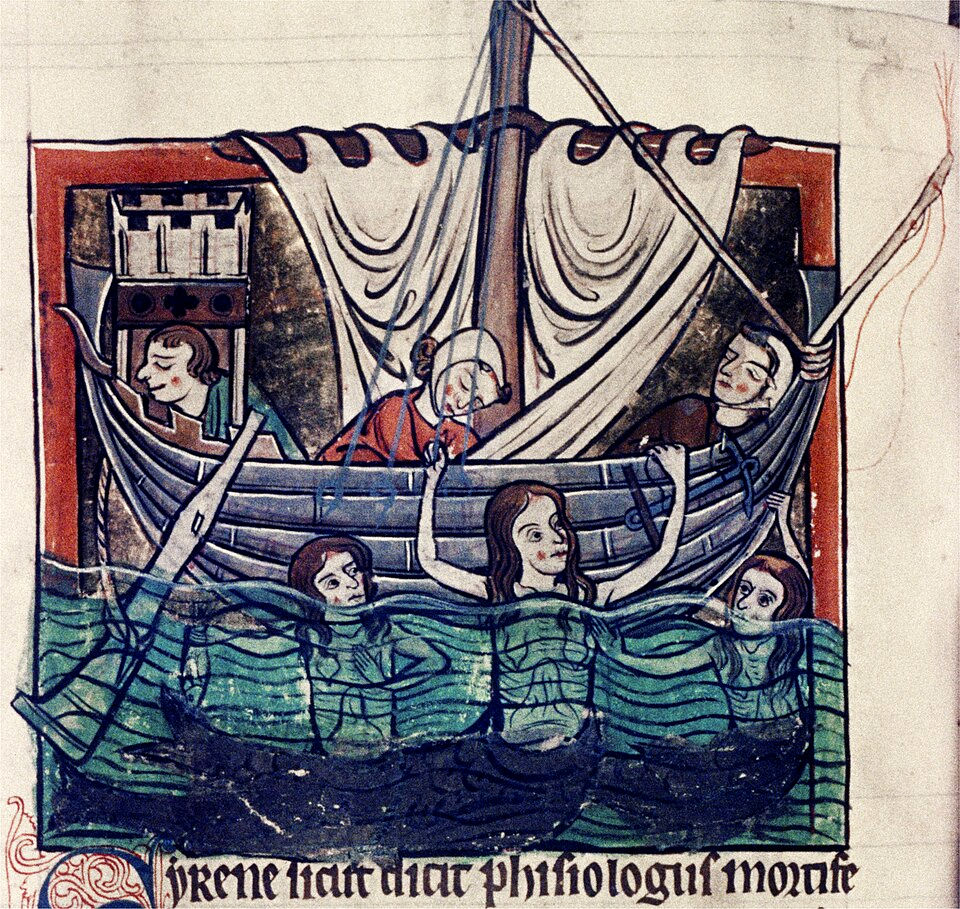
During the medieval age, sirens began taking on their more familiar form of mermaid-like creatures with enchanting voices. This siren transformation shows how as cultures and religions evolve, so too do the mythologies and stories we tell.

The Nereids were beautiful sea nymphs in Greek mythology, daughters of the sea god Nereus ("the Old Man of the Sea") and the Oceanid, Doris. The Nereids were often depicted as fully human women living with their father in his shimmering silver cave in the Aegean sea. They were benevolent and helpful to sailors. In ancient Greek art, the Nereids were frequently portrayed as riding on dolphins or other sea creatures.
The fusion of tales from Near East traditions regarding Atargatis and the kulullû combined with Greek siren and sea nymph mythology developed into the seductress mermaid mythos. Mermaids were now beautiful creatures enticing sailors to their doom with mesmerizing songs. They were viewed as dangerous creatures and usually to be avoided by those at seas.
The Enchanted Waters of Europe
Celtic Culture

In Celtic folklore—spanning Scotland, Ireland, Wales, Cornwall, Isle of Man, and Brittany—mermaids embody different shapes and meanings. One example is the selkie, a creature described as a seal that could shed its skin to become human. These shape-shifters possess a fascinating dual personality: they can be kind and benevolent towards humans one moment, but fiercely vengeful and unpredictable the next.
In their human form, selkies are often depicted as exquisitely good-looking. Scottish and Irish legends revolve around these creatures forming connections with humans, which usually lead to romantic entanglements and even offspring. But beware—these relationships can be fleeting and heartbreaking for both parties involved.
What happens when a selkie is separated from their seal skin? In many tales, a cunning individual, usually a lover, will steal or hide the selkie's skin, forcing them to remain on land against their will. The consequences can be dire: the selkie may become trapped in human form—desperate to return to the sea but unable to do so.

In Welsh folklore, we meet Gwenhidw, a legendary morforwyn (Welsh for "sea maid"), who has captivated hearts for centuries. Her name is nothing short of magical—"Gwenhidw" translates to "white enchantment" or "white spell," hinting at the mesmerizing power she possesses.
In modern retellings, Gwenhidw's story takes on this form: she's the majestic owner of a herd of gleaming white horses or sheep that gallop effortlessly along the crests of the waves. These ethereal steeds are said to symbolize the untamed beauty of the ocean, while their rider is the embodiment of magic and wonder.
In the ancient tales, Gwenhidw's tale is a bit different. Here, she's depicted as a powerful, mystical figure with control over the waves—her flock of ewes consists of foaming waves, with each ninth wave being the mighty ram that leads the rest. An early poem has Gwenhidw growing a beard, hinting at the British tradition of mermaids not being quite that attractive.
Scandinavia

Perhaps the most dangerous mermaid-like creature is the nixie. Originating in the folklore of the Germanic and Norse peoples, nixies are shapeshifting water spirits that may appear as humans, mermaids, mermen, snakes, fish, horses or sunken treasure. Their name varies by region—Nix, Nixe, Nyx (German); Nøkk, Näcken, Nix (Nordic, often male).
Nixies have a deadly reputation thanks to their behavior—they often have a furious temperament and can control water and the weather. They can inhabit any body of water—specifically, streams, rivers, ponds, lakes, the seas, and even, wells. A telling sign of their true identity is water dripping from their clothes or a pool of water at their feet.
Adding to nixies' malicious reputation is the mythology of their ruler being Nikr, an Icelandic name from which arises "Old Nick," or the Devil. Nikr is the father of all the nixies. He has a strict prohibition against nixies intermarrying with humans, even talking to humans warrants death ("Nixie: The SCARIEST Little Mermaid", Storied Channel, https://youtu.be/HuDSMkqwLi0time, time stamp 2:26+).
Nixie stories have the same seductive thread—a beautiful woman or man rises from the water, ensnares a susceptible person, and drags them underwater to drown the poor victim. It is a characteristic danger shared with open-seas mermaids.
Male nixies appear as handsome men or half-human creatures, often luring people with music on a violin or harp by a river or a waterfall. The mesmerizing music, performed by the male nixie at dusk or at night, induces a trance-like state, especially in women and unbaptized children. Hearing enchanting music by a river or lake, however, should be taken as a warning of an impending water death.
Other times a nixie takes on a grand beastly shape—as a horse carrying its willing rider straight into a crystal palace beneath the waves. This horse resembles kelpie legends.
Whether the nixie lures with music, singing, or imitating a crying baby, once the victim strays near enough, the nixie seizes them, pulling them under the surface. Because so many Scandinavian villages depend on nearby rivers, lakes, and mill ponds, all these legends may have been told as cautionary tales for people, especially children, to be careful when wandering close to the waters.
Mermaids in Different Cultures Around the Globe

Mermaids are a global phenomenon, appearing in diverse cultures far beyond Europe.
North America
In Inuit mythology among the indigenous people of Alaska, Canada, and Greenland, Sedna is a powerful spirit of the ocean and sea goddess residing in the Arctic Circle waters. Also known as Arnakuagsak and Sassuma Arnaa, Sedna is revered as a symbol of fertility and abundance.
According to one legend out of the many versions, Sedna was a ravishing beauty who kept refusing marriage to hunters in her village. One day, her father gave her away in marriage to an unknown hunter in exchange for fish, unaware that the suitor was actually a giant bird spirit in disguise. The hunter takes his bride to his nest, and as soon as the hunter transformed back into his true form, voracious birds closed in on Sedna. Her father rushed to help her, and they tried to escape out of there by kayak.
However, the giant bird spirit became angry and triggered a fierce storm. Sedna's father was forced to throw her overboard into the sea as an offering to appease the spirit. Desperately hanging onto the kayak, Sedna's hands froze and her fingers fall off to transform into the creatures of the sea. As she plummeted down to the bottom of the ocean, she changed into a mermaid-like creature with a fish tail.
Asia

Meanwhile, in Asia, tales of mermaids come alive in various forms, but they aren't described as beautiful and seductive. The Japanese legend of the ningyo (human fish) depicts a creature that resembles a fish with a human head—sometimes with golden horns, red bellies, and eyes in their torso. Ningyo can be up to thirty-five feet long, so they're on the scale of large aquatic monsters.
There is one famous legend of eating ningyo meat. Yao Bikuni, was a woman who ate the flesh of a ningyo and gained immortality. She lived for 800 years as a Buddhist nun before eventually choosing to end her life out of weariness. Eating ningyo flesh and obtaining eternal life (or eternal youth) is a recurring theme across many regional variants of this legend.

Additional folklore suggests capturing a ningyo leads to misfortune. A ningyo washing ashore or appearing near a village was thought to foretell of disaster, war, tsunamis, or plague.
Hindu mythology tells of Suvannamaccha ("golden mermaid"), a mermaid princess whose story has been woven into the epic tale of Ramayana in various Southeast Asian cultures. Born as the daughter of Ravana, this alluring figure makes a memorable appearance in Thai and other regional adaptations.
Suvannamaccha attempted to subvert Hanuman—a beloved monkey deity who plays a central role in Ramayana—in his mission to build a bridge to Lanka by stealing stones so that he couldn't build. However, as fate would have it, she finds herself enamored by the monkey deity, leading to an unexpected twist in their story. Suvannamaccha ends up helping Hanuman complete the bridge, and in some lore, she bears him a son named Macchanu.
Africa
In African folklore, Mami Wata—a complex blend of mermaid, water spirit, and goddess. Spanning across Western, Eastern, and Southern Africa, her presence is felt in various traditions, where she is revered for her multifaceted powers.

Mami Wata is often depicted as an elegant, half-human, half-fish entity, adorned with flowing locks of hair and sometimes accompanied by a mirror and a serpent. Her appeal extends beyond physical appearance, for she is believed to possess the power to bestow good fortune or misfortune upon those who encounter her.
As a powerful deity, Mami Wata is worshipped for her ability to provide spiritual and material healing, as well as safeguarding water bodies from harm. However, she also embodies darker aspects—capable of causing destruction and disease if not appeased or respected. In some African legends, Mami Wata is accompanied by her male counterpart, Papi Wata, whose characteristics are often drawn from the Hindu deity Hanuman.
Russia/Slavic Regions

In Slavic cultures, the rusalka mythology is prevalent and associated with fertility, protection, and love and death. Rusalki (rusalka, singular) are believed to be the souls of young women who have died in a tragic manner, such as being drowned, burned at the stake, or having their lives cut short by some other unjust means.
These female souls reside in rivers, lakes, marshes and streams, and are said to retain their human emotions, memories, and personalities. The similar strategy of seducing men by song or through their beauty, only to drag them to a watery grave is prevalent for the rusalka mythology. They frequently hold magical control of water (affecting tides, creating whirlpools) and weather (commanding rain, hail, and storms).
Around the Ukraine and Danube regions (rusalki here are called vila), the water creatures are depicted as beautiful, pale-skinned women with blonde, light brown or green hair, having eyes without pupils, and dressed in light sheer robes resembling mists. They sing bewitching songs and dance in rings under the moonlight. These rusalki are generally benevolent and have links to fertility and agriculture.

In Northern Russia, rusalki shed their romantic appearance, becoming ugly, unkempt, wicked, and eager to ambush the unwary. Feral and dangerous, these creatures are nothing like their gentler Slavic counterparts. It's tempting to read this harsher portrayal as a mirror of the land itself—where the environment turns unforgiving, so too does its rusalka folklore.
Certain Russian and Ukrainian folklore describe rusalki as small children or doll-like, particularly tied to the belief that unbaptized children's souls can become rusalki. This theme is important as it occurs in many cultural folklore about the souls of the "unclean dead"—those of unbaptized children, a virgin who was drowned, or people who died of suicide—being changed into restless spirits wandering the earth.
In the Chernihiv region, dying during Trinity Week carries a strange fate: regardless of gender, the dead rise again as rusalki, their original gender intact. Trinity Week—also called Rusalka Week or Green Week—occurs in early June, the week after Pentecost and Trinity Sunday, when the line between the living and the water-bound dead was said to blur. It's a striking exception to rusalka lore: here, the water doesn't just claim drowned maidens to become these creatures—it claims the men too.
The Renaissance Influence and Modern Depictions

The Renaissance sparked a revival of interest in mythology and the arts, shaping contemporary views of mermaids. Writers like Hans Christian Andersen reimagined these figures in stories emphasizing their beauty and tragic elements.
Andersen's The Little Mermaid stands out as perhaps the most famous modern retelling. This tale dives into the complex emotions surrounding desire and sacrifice, resonating with readers in a profound way. With over 30 adaptations in film and theater, this story illustrates how mermaids have become symbols of femininity, longing, and tragedy in the modern world.
Today, mermaids are shown in various shapes, from playful characters in animated children’s films to darker, more complex portrayals in horror stories. This versatility ensures mermaid legends continue to evolve while holding onto their timeless charm.
Specific examples include: For books—To Kill a Kingdom by Alexandra Christo (2018) and The Deep by Rivers Solomon (2019); for TV series—H2O: Just Add Water (2006–2010), Mako Mermaids (2013–2016), Siren (2018–2020), and Once Upon a Time (2011–2018); for films—The Little Mermaid (1989), Splash (1984), The Shape of Water (2017), and Ponyo (2008).
Modern Significance of Mermaids

In the past, the dangerous trope of mermaids as seductresses preying on men, reflected patriarchal cultures' fears of liberated women and the distressing changes that come with more freedom for women. As women became more liberated in the modern world, so have mermaids in their lore. They now symbolize personal empowerment and freedom.
In modern literature, TV series, and movies, mermaids take on roles as protectors of the sea, fighting for their homes with bravery. They have evolved to become independent figures who challenge societal expectations.
Often tied to the ocean, mermaids also represent the latent strength found in femininity and nature. With the oceans facing severe threats from pollution and climate change, they have become icons of conservation efforts. Modern mermaid stories promote a sense of responsibility for marine life, reminding humanity of our integral relationship with the natural world.
Final Thoughts

The origins of mermaids reveal a rich history woven from diverse cultures, ancient beliefs, and artistic expressions. From the goddess Atargatis to today's empowered figures, mermaids have traversed time and geography, captivating our imagination.
As we explored these magical legends, we are reminded of their everlasting messages about beauty, love, and sacrifice. Mermaids will continue to inspire wonder as they swim through the depths of our collective consciousness, encouraging us to listen to the voices of the ocean and cherish its mysteries.
By Mel Bridges


Comments